
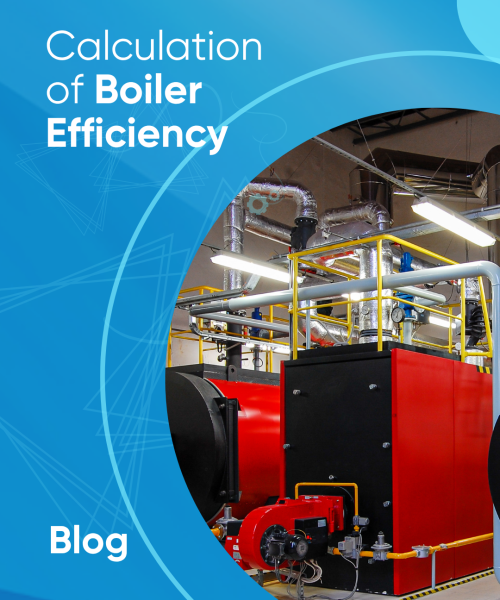
Boilers are essential equipment in industry for generating steam or hot water, used in industrial processes, heating, and other services. One of the most important aspects of boiler operation is efficiency, as it directly influences operating costs and environmental impact. In this article, we will explore how to calculate boiler efficiency, the available methods, and the factors that affect performance.
Boiler Efficiency Calculation: Complete Guide
Boilers are essential equipment in industry for generating steam or hot water, used in industrial processes, heating, and other services. One of the most important aspects of boiler operation is efficiency, as it directly influences operating costs and environmental impact. In this article, we will explore how to calculate boiler efficiency, the available methods, and the factors that affect performance.
What Is Boiler Efficiency?
Boiler efficiency is a measure of how effectively the energy from fuel is converted into useful heat. An efficient boiler minimizes energy losses and maximizes the amount of heat produced for a given amount of fuel.
Types of Efficiency
There are two main types of boiler efficiency:
-
Direct thermal efficiency: Measures the ratio between the heat used to generate steam and the total heat supplied by the fuel.
-
Indirect thermal efficiency: Calculates individual heat losses and determines efficiency by subtracting these losses from 100%.
Direct Method for Boiler Efficiency Calculation
The direct method is simple and easy to understand. It is based on measuring the amount of energy entering the boiler as fuel and the energy leaving as steam.
Direct Efficiency Formula:
Where:
-
Useful Heat Output is the amount of heat generated by the boiler (in kJ/kg or kcal/kg).
-
Fuel Energy Input is the total energy provided by the burned fuel (in kJ/kg or kcal/kg).
Example Calculation
Suppose a boiler uses 50 kg of fuel per hour with a calorific value of 40,000 kJ/kg and generates 2000 kg of steam per hour at a temperature of 150°C.
Fuel Energy Input:
50 kg × 40,000 kJ/kg = 2,000,000 kJ
If the steam generated has an enthalpy of 2,700 kJ/kg and the feedwater has an enthalpy of 300 kJ/kg, then:
(2,700 − 300) kJ/kg × 2000 kg = 4,800,000 kJ (Useful Heat Output)
Finally, the efficiency is:
(Note: This value is theoretical and not realistic — actual boiler efficiency is always below 100%.)
Indirect Method for Boiler Efficiency Calculation
The indirect method determines efficiency by considering all energy losses in the boiler. It is more accurate and detailed, as it identifies the main sources of loss.
Indirect Efficiency Formula:
Main Losses Include:
-
Flue gas losses: Heat escaping with combustion gases.
-
Moisture in fuel: Energy consumed in evaporating fuel moisture.
-
Radiation and convection losses: Heat lost through the boiler surface.
-
Unburned fuel losses: Energy lost through unburned fuel in ash or flue gases.
Example Calculation
Suppose the following values are obtained:
-
Flue gas losses: 10%
-
Fuel moisture losses: 2%
-
Radiation and convection losses: 3%
-
Unburned fuel losses: 1%
Then the efficiency is:
100 − (10 + 2 + 3 + 1) = 84%
Factors Affecting Boiler Efficiency
-
Type of fuel: Fuels with higher calorific value generally provide better efficiency.
-
Air-fuel ratio control: Proper mixture ensures complete combustion and reduces losses.
-
Boiler insulation: Good insulation reduces radiation and convection losses.
-
Maintenance: Scale and deposits on heat transfer surfaces can reduce efficiency.
Improving Boiler Efficiency
-
Optimize combustion: Use gas analyzers to adjust the air-fuel ratio.
-
Use economizers: Recover heat from flue gases to preheat feedwater.
-
Water treatment: Minimize scaling to improve heat transfer.
-
Regular maintenance: Clean and service key components regularly.
Conclusion
Boiler efficiency calculation is crucial for cost-effective and sustainable operation of steam and heat generation systems. Using both direct and indirect methods provides a clear picture of performance and areas for improvement. Implementing maintenance routines, combustion optimization, and heat recovery practices can help maximize efficiency and reduce operational costs.
